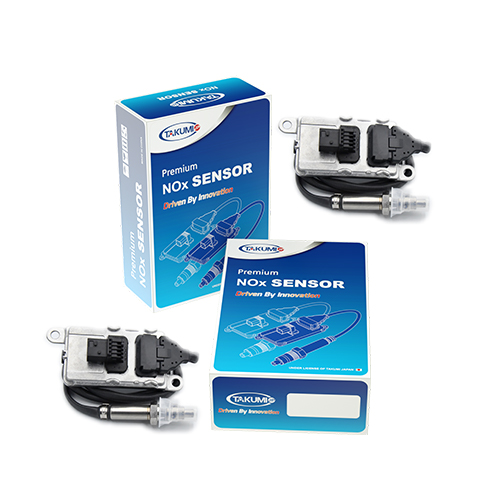
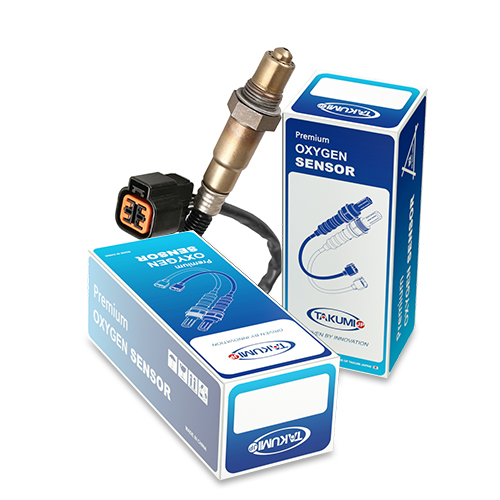
The oxygen sensor, sometimes known as an o2 sensor, is an integral part of modern vehicles. It detects how much oxygen is present in the exhaust and reports that information to the ECU (ECM). The Takumi ECM uses this information to fine-tune the air/fuel ratio, so optimizing efficiency, economy, and emission control.
Oxygen sensor failure due to wear and strain can have lasting negative consequences on engine performance. We will discuss the many types of oxygen sensors, their functions, and how to test them, as the oxygen sensor's accuracy depends on regular testing and replacement.
Takumi oxygen sensors can be either narrowband or wideband. The sensitivity of these sensors and the range of oxygen concentrations they can detect are two key areas of differentiation.
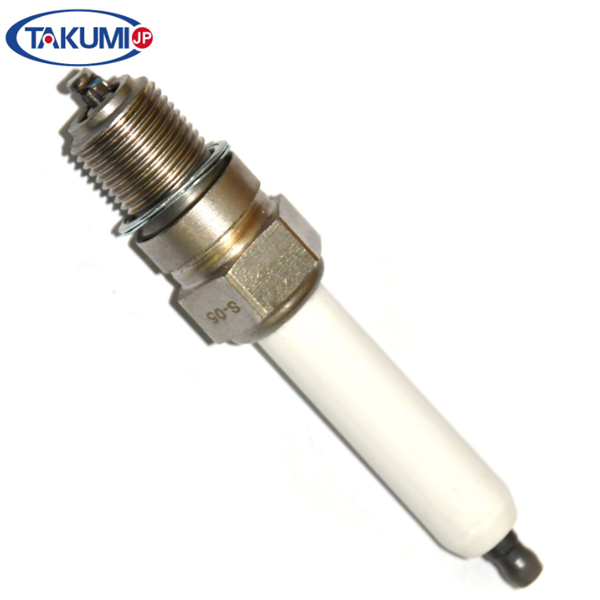
The most common type of o2 oxygen sensor used in vehicles nowadays is a narrowband sensor. A zirconia ceramic cell is used to analyze the exhaust gases for oxygen content. The amount of oxygen in the exhaust fumes affects the voltage output of the ceramic cell.
The oxygen concentration variations that are detectable by Takumi narrowband sensors are limited to a narrow band (0.1 to 0.9 volts). They simply indicate whether or not the air-to-fuel ratio is ideal. They only specify whether the ratio exceeds or falls short of the stoichiometric value, but no other numbers are provided.
.jpg)
Takumi wideband sensors, the most up-to-date type of oxygen sensor, provide a more accurate reading of the air-to-fuel ratio. Its foundational technology, planar zirconia cells, permits oxygen concentration measurements over a much wider range (0 to 5 volts).
Wideband sensors can be employed in place of binary indications to provide more precise readings of the air/fuel ratio. Lambda, the actual air-to-fuel ratio's departure from the ideal stoichiometric ratio, is another detectable property.
.jpg)
The engine control module receives oxygen sensor testing or data from all tests. The Takumi ECM fine-tunes the air/fuel ratio using this data to improve efficiency, economy, and emission control.
A zirconia ceramic cell, a heating element, and two wires make up the exhaust system's oxygen sensor. The ceramic cell's platinum-plated sides are enclosed in a strong metal cage. The cell generates voltage from exhaust gas oxygen.
Heat the sensor quickly with the heating element. The sensor must be heated to 600 degrees Celsius to work, making the heating element crucial.
Takumi Japan auto parts business section is specialized in the design, manufacture and distribution of ignition system parts Filtration system components and Hybrid batteries around the globe. Takumi Japan has a reputation for quality and its customers love it. Takumi Japan has built a skilled team that can serve international markets. We regularly participate in major international exhibitions to assist our clients be recognized in their local markets.
There is only one distributor only available in one region. Our products include motorbike and automotive parts, such as spark plugs for industrial generators, spark plugs to motorcycles, filters, ignition cables, bearings and spark plugs. Our brand is Japanese technology. Our products are able to be comparable to the standards and quality of OE.
We are home to more than 42 fully auto-operated production lines. This allows us to increase our annual production of 300 million super torchs. Takumihas Professional Spark Plug Research Institute and Testing Centre is the Secretariat Section of the Sub-Committee of National Automotive Standardization Technical Committee. It has reached the top level of excellence in the industry.
Takumi is a pioneer in product design and development, which has been around for more than 50 years. Also, creates other industries like Water pumps. Water seal. Special Ceramics. Ignition Coil. Ignition Cable. Filter. Generator. Spark plugs with copper-core, Platinum spark plugs, Iridium Spark plugs Spark plugs that Pin to Pin plugs, are widely utilized in automobiles, Motorcycle, Small Gasoline, Gas engines, Industrial engines, and other industries. The number of OEMs employed in the United States is greater than 40 percent. It is exported to Europe and North America, South America. Japan, South Korea, Southeast Asia and other regions. The industry's leaders are the ignition coil's design and the high-quality. Natural gas engine products make up more than 60% of the market.
The Takumi ECM needs two wires to connect the sensor. The ECM sends the sensor a low voltage signal (usually 0.5 volts), and the sensor returns a voltage signal that varies with exhaust gas oxygen content.
Assessment Methods for Oxygen Sensors Oxygen sensor accuracy can be tested with several tools. Techniques include: Looked Over
Check the sensor for wear and damage first. Look for rust, cracks, and other deterioration on the sensor and cables. Check for water damage or oxidation at the connector.
If the sensor appears broken, replace it immediately. Low engine performance and greater emissions arise from faulty oxygen sensor readings.
To ensure that an oxygen sensor's heating element is working properly, it must be subjected to a resistance test. The heating element's resistance should be between 6 and 10 ohms. A faulty heated oxygen sensor would generate findings outside of this time frame.
Remove the oxygen sensor from its harness and use a multimeter to measure the resistance of the heating element. If the measured resistance exceeds the allowed range, the Takumi sensor must be replaced.
A voltage test is performed by measuring the voltage output of an oxygen sensor with a multimeter. Start the automobile and connect the multimeter to the wire coming from the oxygen sensor.
Takumi narrowband sensor's voltage reading should be between 0.1 and 0.9 volts, while a wideband sensor's value should be between 0 and 5 volts. If the voltage measurement of the sensor is too high or too low, it should be replaced.
 EN
EN  AR
AR DE
DE ES
ES FR
FR HI
HI JA
JA PT
PT RU
RU